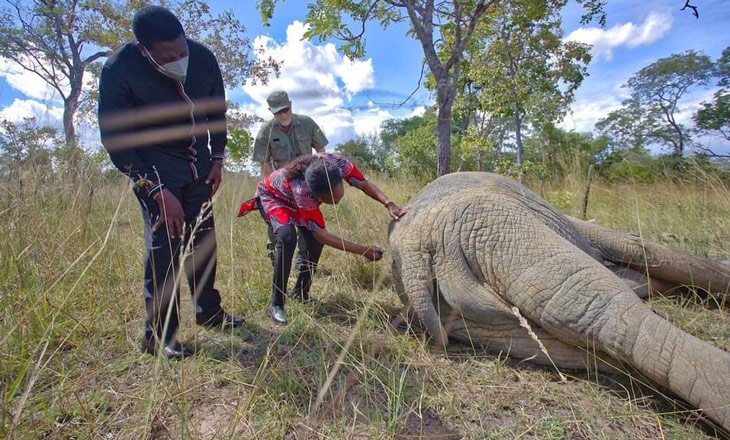
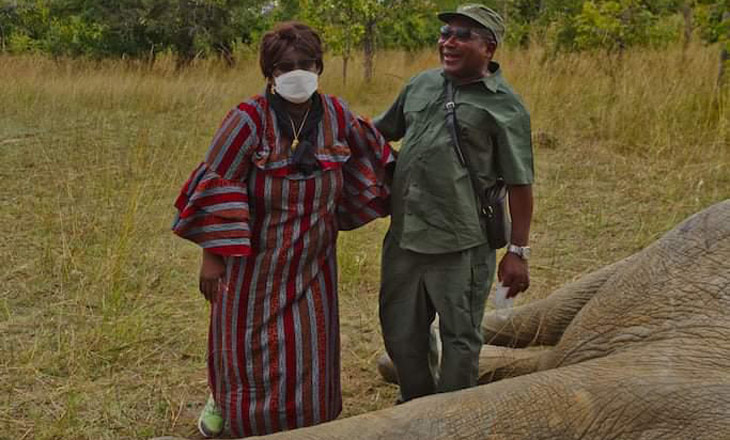
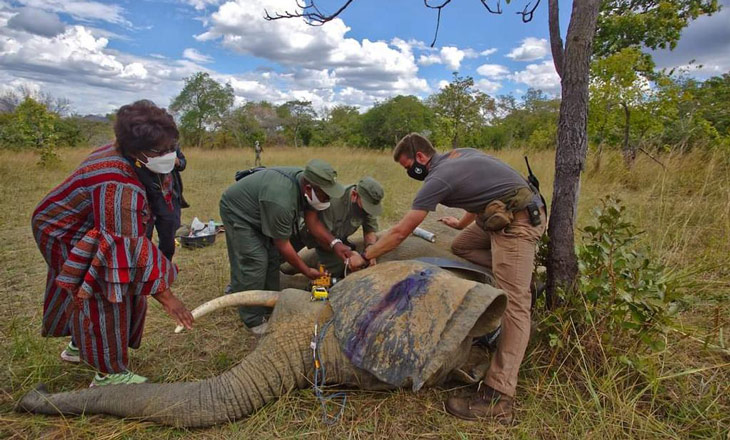
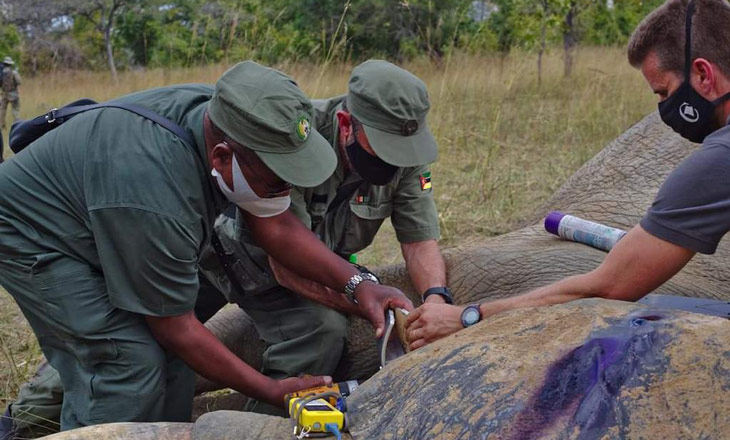
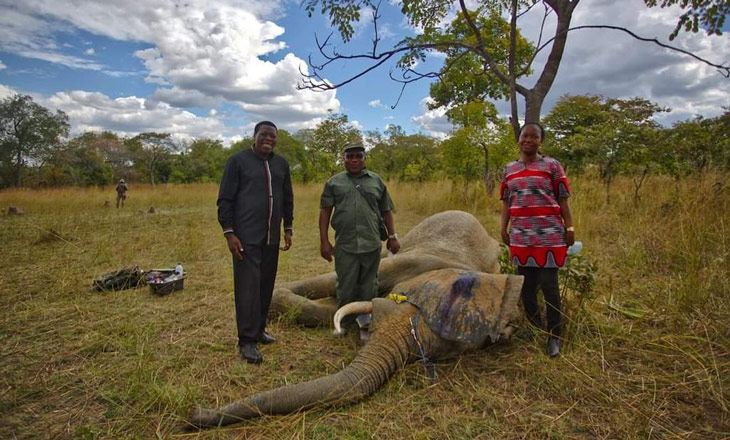
During their visit to the headquarters of Niassa Special Reserve, the President of the Republic, Filipe Jacinto Nyusi and the First Lady, participated this Saturday, 31 July 2021 (World Ranger Day) in the operation of exchange of Satellite monitoring collar.
In 2018, the President of the Republic visited the Niassa Special Reserve and participated in the collar exchange operation, christening an elephant with the name “Mr President”.
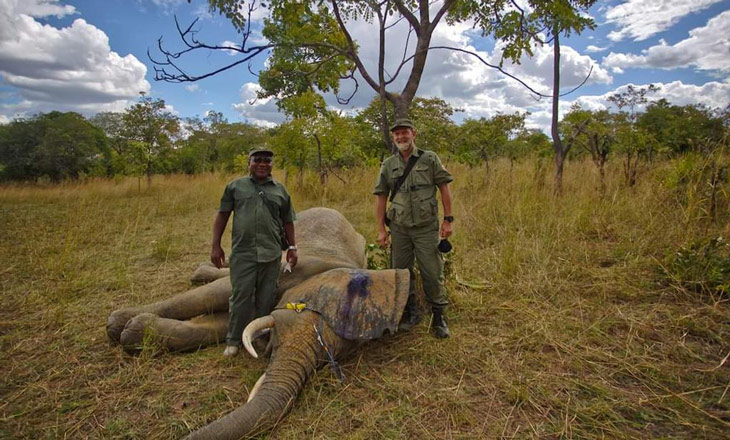
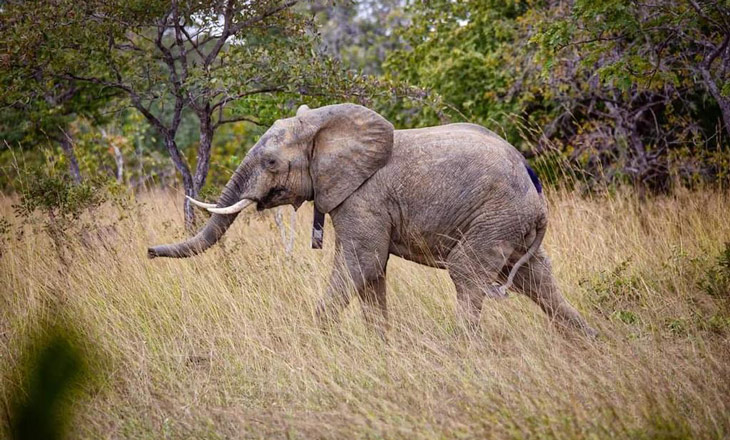
This year, the President of the Republic and his wife participated in yet another operation to change the collar of the elephant known as “Mr. President”, after several attempts to locate him, President Filipe Nyusi and the technical team of the collar exchange operation decided to put the collar on another elephant to which the President of the Republic named Mr. “The Gentleman”.
The placement of monitoring collars via satellite is one of the technological interventions introduced in our Conservation Areas to control the movements of animals, elephants in particular, due to their various seasonal movements including food preferences, which makes it possible to better plan the inspection effort as well as prevent human-animal conflict.
This satellite monitoring collar exchange operation was also witnessed by the Minister of Land and Environment and the Minister Arid and Semi-Arid Lands of the Republic of Kenya.

The celebration of the 10th anniversary of the National Administration of Conservation Areas (ANAC) this Tuesday, May 25, 2021, takes place at a time when the commemorative week of Biological Diversity is also celebrated, having been celebrated on May 22, the International Day for Biological Diversity was proclaimed by the United Nations, as well as the 50th anniversary of the Bazaruto Archipelago National Park.
This year, the celebrations have as their motto “Conserving Biodiversity in Mozambique” which is a message and a call for everyone to look more at biodiversity, conserve and protect it.
Biodiversity, whether a species or an entire ecosystem, is vital to the health and well-being of human beings. The quality of the water we drink, the food we consume and the air we breathe depend on the good health of nature.
Due to restrictions due to COVID-19, ANAC’s 10th anniversary celebrations will be marked by the exhibition of videos, events on the communication platform, interviews with the media, lectures by the institution and partners on different communication platforms, including the institution’s social networks.
The challenges of ANAC are to improve management capacity, to strengthen the fight against poaching, to maintain self-sustainability in the management of conservation areas, to share economic benefits with local communities, as well as to train human resources and rehabilitate areas. of conservation with the construction and maintenance of management and tourism infrastructures, the continuation of the reintroduction of emblematic species for tourist attraction and restoration of ecosystems.
On this occasion, ANAC intends to express a word of appreciation to its cooperation partners, local communities and the private sector that for the past 10 years have supported the conservation of ecosystems, protecting biological diversity and promoting the well-being of local communities living within and around conservation areas.
The Maputo Special Reserve (MSR), in Matutuíne district of Maputo province, destroyed, last Friday, 38 weapons of different calibers recovered from poachers, which 26 are homemade and 12 conventional.
The event was witnessed by representatives of National Administration of Conservation Areas, the District Attorney’s Office, the PRM Commando in Matutuíne, community leaders and the reserve management team.
According to the MSR administration, the initiative aims to prevent the same weapons from re-circulating in the world of wildlife crime, undermining ongoing efforts to protect biodiversity in that reserve.
Some of the destroyed weapons were delivered voluntarily to the MSR in sensitization meetings to communities living inside the reserve and in buffer zone regarding the need to combat poaching, and others were abandoned by criminals during the pursuit actions by groups of rangers in their routine patrolling operations.
Another amount of non-quantified weapons recovered from poachers held by reserve’s rangers was handed over to the PRM Commando in Matutuíne to serve as evidence of the crime. Even these, the district attorney’s office has initiated efforts to persuade the police to make them available to be equally destroyed.
The management of national parks and reserves will continue working to reduce significantly the crime rate against wildlife, either by improving research methods or by applying the conservation law which punishes, not only poachers, but also constituents and who possess products resulting from illegal hunting.
In fact, in mid-August, the National Administration of Conservation Areas organized, in Maputo, a workshop to train rangers from parks and reserves in order to improve their technical capacity to identify evidence at the scene of crime regarding the fight against poaching and illegal trade of wildlife products.
At the time, the General Director of ANAC, Mateus Mutemba, said to be happy with the level of collaboration between the management of conservation areas and prosecutors and judges in the fight against environmental crimes, resulting in the conviction of poachers to prison sentence of 9 to 12 years.
The National Administration of Conservation Areas is concerned about cases of release of individuals accused of committing environmental crimes by paying a deposit, which often does not exceed one tenth of the value of the purchase of the weapon used.
The information was made public by the General Director of ANAC, Mateus Mutemba, who spoke on Thursday (16) in Maputo, at the opening of the two days seminar to train rangers of conservation areas regarding issues related to evidence collection in the place of crime against the environment.
Inserted in the framework of actions to combat poaching and illegal trade of wildlife products, the event aimed to improve the ability of technicians to identify evidence of crime, focusing on fingerprinting techniques using modern equipment.
Despite the efforts of different actors in the fight against poaching, which has been resulting in an increase of cases of conviction of furtive persons for greater prison terms, the authorities remain concerned about the indices of impunity cases against wildlife crimes.
According to Mutemba, impunity results in the loss of several species of wildlife, in the case of the elephant that in the last eight years its population has reduced by 53 per cent, with focus on Niassa National Reserve, which registered a decrease in the order of 60 per cent.
It is estimated that in the last five years at least 65 leopards, 80 lions, 44 hyenas and 25 wild dogs have been slaughtered in the Niassa reserve, using silent methods, consisting in use of traps and ties, to support the illegal trade in bones, nails and teeth of these species.
Another concern has is related to rhino hunting in the transboundary areas between Mozambique and South Africa, with data indicating the loss of about 7,000 animals from 2008 to this part.
The rhino is almost non-existent species in Mozambican conservation areas, and the few that still cross border to Mozambique coming from South Africa, do not survive for more than 48 hours.
In the first six months of this year alone, 260 rhinos, an average of one rhino per day, were illegally slaughtered, resulting in the conviction of a little over 65 Mozambican citizens sentenced to prison terms ranging from 8 to 24 years.
Official data from the first half indicate an increase in pouching activity, including incursions, in cross-border conservation areas from 638 to 759 cases, corresponding to 18.9 percent compared to the same period in 2017.
The training organized by ANAC in partnership with the British High Commission and the International Fund for Animal Welfare (IFAW) comes in response to the need to train technicians dealing with environmental crime issues that the mozambican government has been preserving so that the next generations have access to the ecological goods and services that the nature offers.
Fire that occurred last Monday, with some outbreaks in the following day, is already under control at the Maputo Special Reserve (REM). The fire broke out near the road linking the city of Maputo with the village of Ponta do Ouro.
According to the Park Warden, Miguel Gonçalves, the fire, which causes are not yet known, did not cause incidents in wildlife.
The area affected by the flames is estimated at about six hundred hectares, however, Gonçalves has given assurances that the incident will not endanger the normal course of wildlife management activities, nor the tourism that is practiced in that conservation area.
Burnings are a phenomenon that occurs annually throughout the country, most notably at this dry time of the year. The origins are varrious and include the opening of agriculture fields, opening of new pastures for cattle, poaching, oversights in the management of small fires, among others.
According to the analyzes carried out by Ministry of Land, Environment and Rural Development, MITADER, the records show a remarkable reduction of the levels of fires in REM, in comparison with the previous years.
This reduction is a result of ongoing awareness-raising work that the reserve has been doing to communities living in surrounding landscapes, as well as increased enforcement efforts.
Fire has an important ecological function in the health of reserve vegetation, however, fires need to be managed in order to maintain adequate frequency and intensity. With the continued collaboration of all, the reserve hopes to be able to keep its habitats healthy and achieve its management objectives.
Created in 1960, with an extension of 1.040 square kilometers, the Maputo Special Reserve has a natural landscape with forests, marshes and dunes. Among the wildlife that it hosts are elephants, zebras, hippos, crocodiles and a variety of antelopes and birds.
The resettlement policy framework prepared for the Biodiversity and Development of Conservation Areas Project in Mozambique – Phase 2 (Mozbio2) is now available.
The document constitutes a safeguard instrument of the World Bank, triggered by the Operational Policy (OP) and was elaborated during the design of the project based on the identified social risks and the evaluation of possible factors triggering the policy.
The work resulted from consultations with the Parks Wardens and members of the Conservation Areas and (CA) teams of all target CAs, along with a wide range of stakeholder interviews. Find the entire document in RPF – MozBio Phase 2.
Launched at a press conference, in Maputo, the International Conference on Nature-Based Tourism, is an annual event taking place for the first time in Mozambique on 7, 8 and 9 next June.
The conference is rotating among members countries of the Global Wildlife Program, a global partnership led by the World Bank, which promotes nature conservation and sustainable development, combating illicit wildlife trade.
“We intend to discuss global issues related to the development of nature tourism in conservation areas. We also want to bring together individuals, experts and conservation partners, to discuss and learn from experiences and good practices in the region and in the world, “said Nilza Chipe, Communications Advisor at the Ministry of Land, Environment and Rural Development (MITADER) -organizer of the conference together with the Ministry of Culture and Tourism.
According to the organizers, the event is aligned with the Government’s policy of developing nature-based tourism, strengthening the role of conservation areas in generating incomes for the country and in developing communities.
At this event, which is one of the largest wildlife conservation conferences in the world, Mozambique has an opportunity to present the enabling environment for investments in conservation tourism, to share national experience in transforming conservation areas into sustainable tourism goods as well as to listen experiences in biodiversity management.
“It will be a milestone in the rebirth of conservation areas in Mozambique, considering the richness of our biodiversity and landscapes. We will be able to share the rich natural capital with the whole world, thus attracting investments to our conservation areas”, concluded Nilza Chipe.
Thirty-nine applicants, three of whom are women, graduated as conservation inspectors during a pass out recently held in Limpopo National Park after eight-week of intensive ranger training course, conducted by Southern African Wildlife College.
During the first two weeks of the course, more than 100 applicants, mostly selected in the surrounding communities of different conservation areas, participated in intensive training to test their mental and physical endurance abilities. Of these applicants, only forty have demonstrated sufficient skills to proceed with the training.
The training had a theoretical and a practical component, both dealing with issues related to anti-poaching operations, such as patrolling, road-blocks, gate controls and arrest procedures. At the time, senior inspectors from the Limpopo National Park, as well as several local institutions, contributed to the training of graduates, especially with regard to sector legislation.
Of the thirty-nine elite inspectors who have completed the course, twenty-nine will be assigned to Limpopo National Park, which continues receiving pressure from poachers of key species such as elephants and lions. The park has also witnessed increase of cases of poisoning and traps, methods used to decimate various species, which include large numbers of vultures and small carnivores important for the balance of ecosystems.
The new members of the class will strengthen enforcement capacity in the so-called Intensive Protection Zone, which borders the Kruger National Park, a measure aimed at protecting areas with greater poaching density and potential for tourism development. The rangers will operate from a new mobile base of field operations, supported by a helicopter, which will greatly increase their mobility.
Still in Limpopo National Park, five other rangers were appointed to offer support to the Carnivore Protection Program. Their specific activities include patrolling and monitoring of carnivores in areas known as carnivorous areas. The measure aims to gain a better understanding of the movement and habits of animals, reduce the potential of man – wildlife conflicts and eliminate threats of poaching.
The remaining five rangers will strengthen enforcement measures and combat illegal poaching and logging in Banhine National Park.
This batch of graduates results from a project initiated by National Administration of Conservation Areas in partnership with Peace Parks Foundation to improve the inspection capacity in Greater Limpopo and Lubombo Transfrontier Conservation Areas.
Last year, the project trained and employed twenty-six rangers in Zinave National Park and five in Banhine National Park, and in the near future plans to increase more thirty rangers to the team of Maputo Special Reserve.
The Prime Minister, Carlos Agostinho do Rosário appointed, last Friday, 16 March, Mateus José Mutemba, as the General Director of National Administration of Conservation Areas (ANAC), replacing Bartolomeu Soto, who held the position since 2014.
The appointment of Mateus Mutemba comes at a time when the Ministry of Land, Environment and Rural Development is initiating a structural reform in the conservation areas sector, from central to local level, regarding to strengthening institutional, technical and human resources capacity in order to face the current challenges.
In his speech, the Prime Minister said that the Mateus Mutemba has the task of ensuring the continuous improvement of the operationalization of ANAC, through training of technicians, planning of the resettlement of people living inside and around the conservation areas, development of the infrastructures for management and tourism in conservation areas, as well as discouragement of illegal practice of mining, hunting and logging.
“We are hopeful that the newly-appointed will respond to the current challenges of ANAC, given his accumulated professional experience, especially in the administration of Gorongosa National Park,” said the Prime Minister.
According to the leader, the Mozambican Government has been implementing actions and measures for good management of natural resources and the environment, with the aim to ensuring a sustainable economic development of the country and a better future for future generations.
Carlos Agostinho do Rosário also acknowledged that the commitment and dedication of the outgoing General Director contributed to the growth of the institution. “We appreciate the significant progress in combating poaching, as well as translocation of animals in our conservation areas, like Maputo Special Reserve,” he said.
At the occasion, do Rosario also called on society to join to the efforts of the Government in protecting and preserving natural resources, increasing vigilance and denouncing practices that destroy the environment, such as poaching, forest deforestation and uncontrolled fires.
About Mateus Mutemba
Mateus Muthemba holds a Master in Public Policy, with a specialization in Development Administration from the Australian National University, a Post Graduate in Development Administration from the same University and a Diploma in History from Eduardo Mondlane University.
He has worked for the last 10 years in Gorongosa National Park, where he has held the position of Director of Human Development (2008-2011) and Warden Park (2011-2018).
Due to his leadership in the restoration of Gorongosa National Park, Mateus Mutemba was recognized as “Conservation Hero of the Year 2013”, during the 36th International Wildlife Film Festival held in Montana in United States of America.
Also in the same year he received the “World Organization for Families” (WFO) Award of Merit in recognition of the work carried out with communities in the buffer zone of Gorongosa Park.
In June 2017, Mateus Mutemba was recognized as the National Geographic Emerging Explorer by the National Geographic Society in Washington DC.
Two promotional tourism videos in conservation areas are finalists at film festivals with tourism and cultural content taking place in India, Asia, and Turkey in Europe.
These are films about the Ponta de Ouro Marine Partial Reserve and the Bazaruto Archipelago National Park, both lasting five minutes.
Belonging to the National Administration of Conservation Areas, the works were produced by the Creative Studio, ANIMA, whose director is João Graça, and show the potentialities and zones of tourist attraction in the two conservation areas.
In the particular case of Bazaruto, the video was chosen from 2,402 out of 113 countries that submitted their applications to participate in the 5th International Short Film Festival on Culture and Tourism (IFFC-V), to be held from 28 to 30 this month in India.
Designed for the “Welcome to Our Home” campaign, it is one of 145 films selected as the finalist of the competition. Meanwhile, the video about the Ponta de Ouro Marine Partial Reserve is a finalist at the Anatolia Tourism Films Competition Festival, which will take place on a date to be announced in Turkey.
The work participates in the category of promotional films along with the other two. In the documentary area, nine films from different countries of the world are set for the final phase.